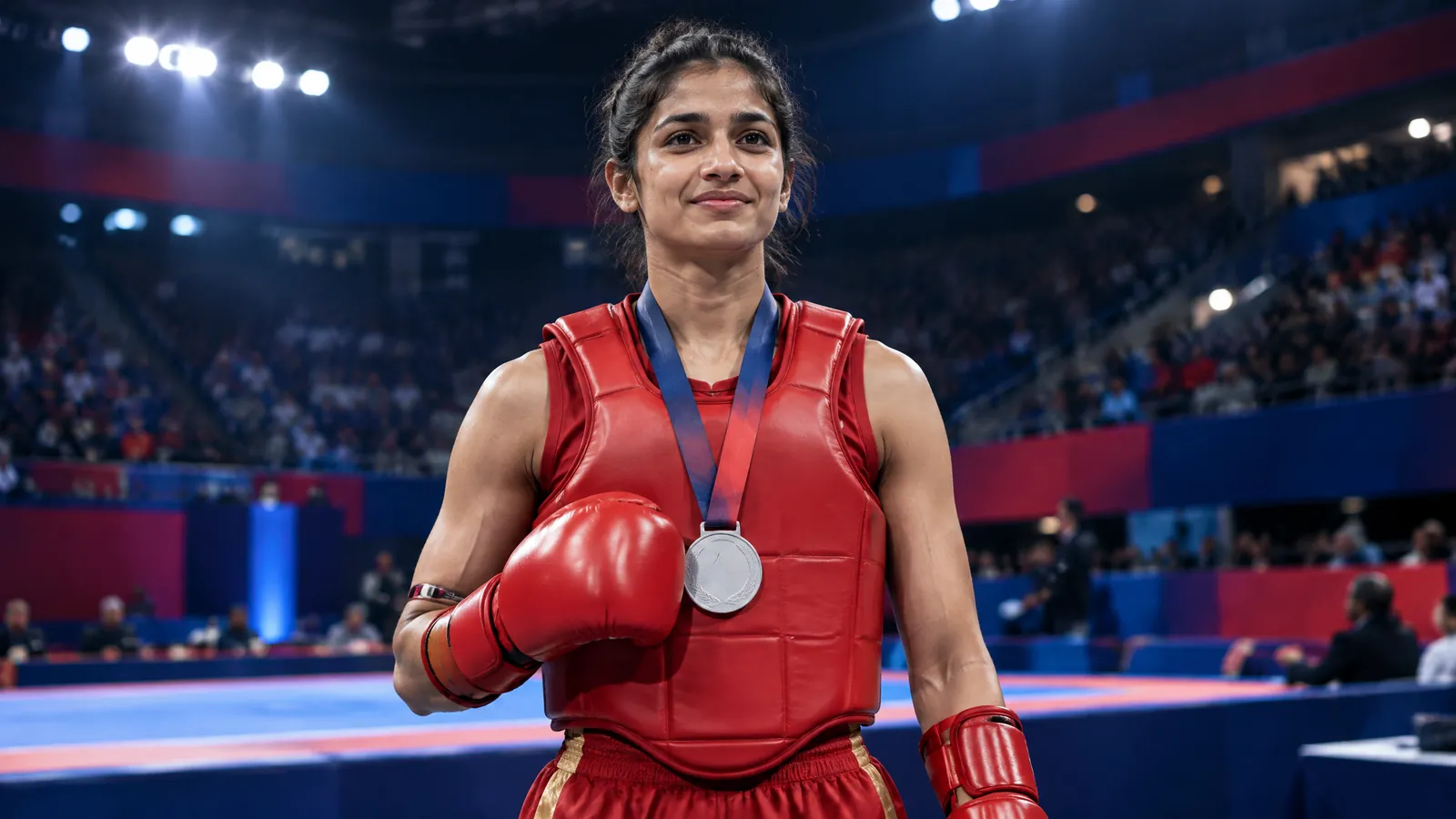
Latest news: Roshibina Devi takes Asian Games silver
For readers following latest news from the Aichi-Nagoya Asian Games, India’s Naorem Roshibina Devi has won silver in the women’s 60kg sanda competition. The 25-year-old lost the final 0-2 to China’s Zhang Xiaoyu at the Aichi Prefectural Martial Arts Hall on Thursday, 24 September. Olympics.com and contemporaneous Indian live coverage both reported the result shortly after the bout.[1] [2]
The final was decisive. The Hindu’s PTI update and India Today reported that Zhang took each round 5-0, with the Chinese athlete controlling the title contest from the outset. That round-by-round score gives useful precision to a result that can otherwise be reduced to ‘silver’: Roshibina did not lose a closely split decision after three rounds; Zhang won the two rounds needed for the match.[2] [3]
Silver is nevertheless a substantial addition to Roshibina’s continental record. It is her second successive Asian Games silver and her third medal across three appearances. The fresh result also gives India a confirmed medal story from a combat sport that tends to receive less routine attention than cricket, shooting or athletics, but demands the same close reading of the official result and the event format.
How the women’s 60kg sanda final unfolded
Sanda is the full-contact combat discipline within wushu; it features punches, kicks and throws, while taolu is the judged-routine side of the sport. Under the International Wushu Federation rules available on its website, a standard bout consists of up to three two-minute rounds, with the athlete winning two rounds taking the bout. The rules provide for sideline judges to determine each round and display their decisions at the head judge’s request.[6]
That framework explains the 0-2 notation in the final. It records the number of rounds won, not a single cumulative score for the full fight. The 5-0 figures reported for each round describe the judges’ decisions in those rounds. Readers should also distinguish the round result from a points-difference result: the latter was relevant earlier in Roshibina’s campaign, but it was not the basis on which the final was decided.[1] [3]
The medal match came at the end of a compact knockout run. Olympics.com reported that Roshibina opened with a points-difference win over Bangladesh’s Shika Khatun in the round of 16 and beat Macao China’s Chu Man Sin by points difference in the quarter-final. She then defeated Indonesia’s Thania Kusumaningtyas 2-0 in Wednesday’s semi-final to reach the gold-medal contest.[1]
A third straight Asian Games medal for Roshibina
Roshibina’s record has developed in a clear sequence: bronze at Jakarta 2018, silver at Hangzhou 2023 and now silver at Aichi-Nagoya 2026. Olympics.com described her as the first Indian to win wushu medals at three consecutive Asian Games. This is a specific, verifiable distinction about successive editions, not a claim that she has won more medals than every Indian wushu athlete in every competition.[1]
Her Hangzhou silver was itself significant. In the 2023 women’s 60kg final, she lost 2-0 to China’s Wu Xiaowei after earlier victories over Kazakhstan’s Aiman Karshyga and Vietnam’s Thi Thu Thuy Nguyen. The Olympic Movement’s report noted that Roshibina’s Hangzhou medal made her only the second Indian to win an Asian Games silver in wushu, after Wangkhem Sandhyarani Devi in 2010.[5]
Consistency is the larger point. An Asian Games medal in 2018, a final in 2023 and another final in 2026 represent results separated by full competition cycles, opponents and host cities. It does not turn a silver into gold, and the gap to the champion in this final was plain. But it provides a more reliable picture of an athlete’s place in the Indian programme than one isolated day’s result. It also keeps an exceptional performance in one division from being stretched into a wider verdict.
Why this India Asian Games wushu medal matters
Roshibina’s silver was India’s only wushu medal at these Games, according to the Olympics.com report on the seven-member Indian contingent. The report said the other Indian sanda competitors mentioned there exited before the medals, while the taolu entrants finished outside the podium places. That makes the women’s 60kg result both a personal achievement and the sole confirmed wushu podium return for India at Aichi-Nagoya.[1]
The result has also drawn official recognition in Manipur. In a public post on Thursday, Chief Minister Yumnam Khemchand congratulated Roshibina on the silver and referred to her three consecutive Asian Games medals. The post is an acknowledgement of the medal, not an independent result sheet; the final score and event details in this report are cross-checked against sports reporting and Olympics.com.[4] [1]
There is a practical reason not to overstate wider conclusions. A podium finish demonstrates the quality of one athlete’s campaign; it does not by itself settle questions about long-term funding, selection systems, coaching depth or the comparative strength of every weight division. What can be said now is narrower and firmer: India has a repeat Asian Games medallist in women’s sanda, and she has produced another final appearance.
What comes next after the Aichi-Nagoya final
For Roshibina, the immediate competition is over. Olympics.com said India’s wushu campaign has concluded and that her silver was its only medal. That closes the sport’s medal calculation for this edition, even as the wider Asian Games programme continues across other disciplines. Readers looking for rolling Indian sporting developments should treat a live schedule or results service separately from a completed wushu final.[1]
The broader Indian agenda at the Games remains busy. On the same morning, Sportstar’s live coverage recorded Satnam Singh and Salman Khan taking rowing bronze, India reaching the mixed 4x400m relay final, and an Indian skeet pair qualifying for their mixed-team final. Those are separate events with their own timings and should not be folded into Roshibina’s individual result or used to infer a final national medal tally before the day ends.[2]
For this article, the verified latest-news line is straightforward: Zhang Xiaoyu won the women’s 60kg sanda gold; Roshibina Devi won silver; and the Indian has now stood on the Asian Games wushu podium at each of the three editions she has contested. Further updates, if any, should add new official information rather than recast a settled final result.
Questions readers ask
What is the latest news on Roshibina Devi at the Asian Games?
Roshibina Devi won silver in the women’s 60kg sanda event at Aichi-Nagoya 2026 after losing the final 0-2 to China’s Zhang Xiaoyu.[1]
What was the Roshibina Devi vs Zhang Xiaoyu result?
Zhang Xiaoyu won 2-0 in the women’s 60kg sanda final. Indian reports said Zhang won each round 5-0.[2] [3]
How many Asian Games medals does Roshibina Devi have?
She has three: bronze at Jakarta 2018, silver at Hangzhou 2023 and silver at Aichi-Nagoya 2026.[1] [5]
What is wushu sanda?
Sanda is wushu’s full-contact combat discipline. It uses punches, kicks and throws; it is distinct from taolu, which consists of judged routines.[1]
Did India win any other wushu medal at Aichi-Nagoya 2026?
Olympics.com reported that Roshibina’s silver was India’s only wushu medal at the 2026 Asian Games.[1]
Sources
- Asian Games 2026: Roshibina Devi wins silver for third straight medal in wushu — Olympics.com. Accessed 2026-09-24.
- Asian Games 2026 LIVE: Roshibina Devi bags second Asian Games silver in Wushu — The Hindu / PTI. Accessed 2026-09-24.
- Called-up for Wushu team in 11th hour, Roshibina Devi wins silver at Asian Games — India Today. Accessed 2026-09-24.
- Manipur Chief Minister congratulates Naorem Roshibina Devi on Asian Games silver — Yumnam Khemchand, Chief Minister of Manipur. Accessed 2026-09-24.
- Asian Games 2023 wushu: India’s Naorem Roshibina Devi upgrades Jakarta bronze to silver in Hangzhou — Olympics.com. Accessed 2026-09-24.
- Wushu Sanda Competition Rules & Judging Method — International Wushu Federation. Accessed 2026-09-24.
Anna News Desk reported this article from Olympics.com, International Wushu Federation rules, an official public acknowledgement and contemporaneous reporting by The Hindu/PTI and India Today, accessed on 24 September 2026. Sports results are reported as confirmed at publication; later programme updates do not alter the completed women’s 60kg sanda final.