At a glance: two September titles frame the moment
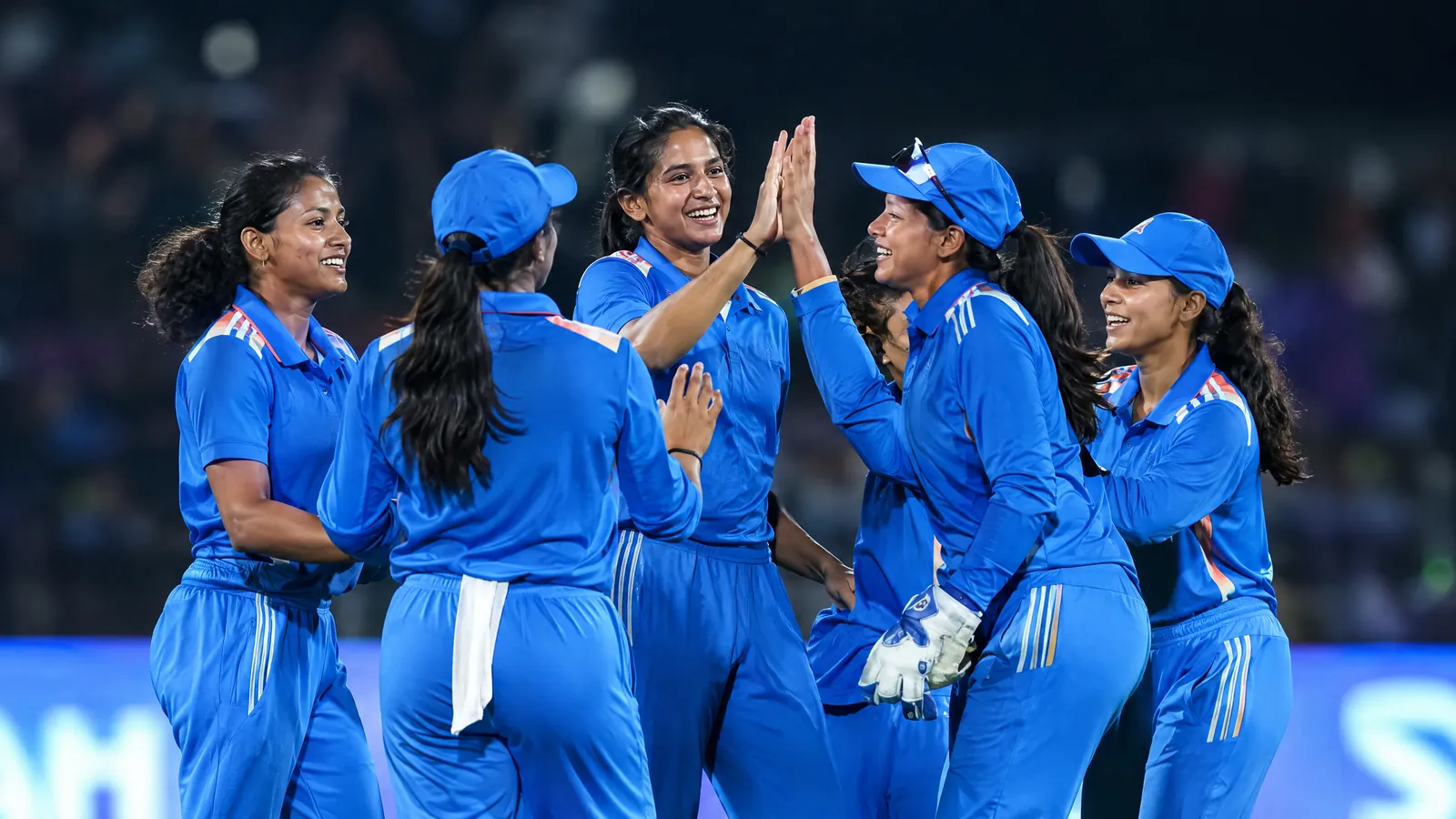
India’s women completed an unusually concentrated run of T20 success in September. On 13 September, they won the Women’s Asia Cup in Dubai, beating Sri Lanka by 72 runs for a record eighth title. Ten days later, they retained the Asian Games cricket gold medal in Aichi-Nagoya, again defeating Sri Lanka in the final, this time by 147 runs. The results put a firm recent marker on India’s place in the regional game, but they are more useful as evidence of a squad taking shape than as a verdict on the wider international order. [1][2]
The short sequence also explains why attention has risen. Financial Express reported a marked Google Trends response to India’s opening Asia Cup match in August, tied to the result, Shafali Verma’s innings and Deepti Sharma’s milestone. Google Trends’ publicly accessible India Explore page was checked for this article; it did not provide sufficient comparable data for a generic team query. That means interest can be described directionally, not converted into a precise current audience measure. BCCI’s prominent follow-up coverage of both titles is a separate official signal of the events’ national relevance. [3][4]
Momentum is deeper than one opening partnership
The Asia Cup final captured a familiar strength. Shafali Verma and Smriti Mandhana added 129 for the first wicket as India made 183 for five; Sree Charani’s four for 20 and Deepti Sharma’s three for 19 then controlled Sri Lanka’s chase. The partnership showed the value of an assertive start, but the bowling figures matter just as much. They point to a side that can build pressure after setting a target, rather than depending only on top-order acceleration. [1]
The Asian Games final offered a larger version of that pattern. Mandhana made 79 from 45 balls, Richa Ghosh finished unbeaten on 49 from 22, and India reached 216 for three. Sri Lanka were then dismissed for 69, with Deepti taking three wickets and Shafali, Charani and Shreyanka Patil taking two each. A scoreline of that scale should not erase the importance of context: tournament opposition, pitch conditions and match situations vary. It does, however, show that India had more than one route to a winning total and more than one bowler capable of shaping an innings. [2]
There were useful reminders during the Asia Cup that momentum is not frictionless. In the opening win over Thailand, India lost wickets quickly after a strong start, according to the official tournament report. Against Bangladesh in the semi-final, a difficult surface required a late push before the bowlers secured a 40-run victory. Those moments matter because a team’s next stage is not simply about repeating its best score; it is about recovering when early plans do not work. [1][3]
A clearer emerging group is gaining responsibility
The established core remains central. Harmanpreet Kaur leads the side, Mandhana is vice-captain, and the experience of Shafali, Deepti and Richa Ghosh gives the batting order and spin attack a recognisable structure. The BCCI’s Asian Games squad also contained multiple wicketkeeping and bowling options, including G. Kamalini, Bharti Fulmali, Kranti Gaud, Arundhati Reddy, Radha Yadav and Nandni Sharma. That named group is a practical indication of the selection pool rather than a promise of identical roles in every format. [5]
Charani’s recent work is particularly illustrative of the changing balance. The 22-year-old slow left-arm orthodox bowler made her international debut in 2025, according to her ICC profile. In the Asia Cup final she took four wickets, and BCCI said she finished the Asian Games as the leading wicket-taker with eight in three matches. Her importance is not just a matter of one final: a left-arm option changes the angles available to a captain and can complement India’s existing spin resources. [1][2][6]
Other names have made contributions in narrower but meaningful windows. Nandni Sharma took three wickets in the Asian Games semi-final, while Kranti Gaud, Prema Rawat and Kamalini each featured in key Asia Cup moments. Shreyanka Patil was selected for the Asian Games subject to fitness clearance and took two wickets in the final. The sensible reading is not that every player has a settled long-term place. It is that India have been able to give newer or less-established players responsibility while retaining a veteran spine. [2][5]
The next cycle is a test of flexibility, not a guarantee
Regional titles are valuable, and India’s unbeaten Asia Cup run underlines a consistent standard in that setting. The next competitive cycle will nevertheless bring different questions: how the batting order handles high-quality pace and spin on unfamiliar surfaces; whether the middle order can rebuild after early wickets; and how the attack performs when a target is small or dew changes the fielding conditions. Those are normal pressures in international T20 cricket, not shortcomings that September’s wins automatically resolve.
Selection will also be part of the story. The Asian Games squad was a 15-player group with experience at the top and several alternatives in specialist roles. Maintaining that depth depends on competition for places, fitness and clarity about each player’s job. A squad can be strong without every member following the same development timetable. For India, the useful measure is whether different combinations can preserve balance between opening intent, lower-order scoring, pace, spin and fielding across a fuller schedule. [5]
The wider context is demanding. India’s June Women’s T20 World Cup campaign had already provided exposure to global opposition before the September tournaments, while the Asia Cup and Asian Games supplied recent high-pressure knockout matches. Results in one event should not be treated as a forecast for another. What they do provide is a body of recent evidence: leading batters have produced quickly, the spin group has taken wickets, and newer players have appeared in decisive situations. The next phase is about testing that evidence repeatedly, rather than declaring a finished team. [1][2]
What happens next
The immediate task is to turn a successful September into a durable process. India’s selectors and coaching staff can use the two tournaments to review combinations, workloads and roles, especially for players who entered matches after limited international exposure. Supporters looking for the next fixtures should use BCCI and ICC schedule updates, because series dates and squad announcements can change and this article does not assume an unconfirmed itinerary.
For a broad audience, the clearest conclusion is measured. India have recent trophies, a high-performing core and credible signs of depth. They also face the familiar challenge of carrying regional success into every condition and against every leading opponent. Interest around tournament games and player landmarks gives that process a larger public stage, but the quality of the next cycle will be decided on the field, over time. External reporting and official sources were reviewed for this explainer.
Questions readers ask
What did India win in September 2026?
India won the Women’s Asia Cup on 13 September and retained the Asian Games women’s cricket gold medal on 22 September, beating Sri Lanka in both finals.
Why is Sree Charani an emerging player to watch?
The left-arm spinner debuted internationally in 2025, took four wickets in the Asia Cup final and led the wicket-taking chart at the Asian Games, according to the ICC and BCCI.
Does recent regional success settle India’s global standing?
No. The titles are strong recent evidence, but future performance will still depend on opposition, conditions, selection and execution across international fixtures.
Sources
- India clinch Women’s Asia Cup Title for the record eighth time — Board of Control for Cricket in India. Accessed 2026-09-23.
- IND-W vs SL-W, Asian Games 2026 cricket: Smriti Mandhana show against Sri Lanka seals India’s first Aichi-Nagoya gold medal — Olympics.com. Accessed 2026-09-23.
- Google Trends: India vs Thailand searches surge after Women’s Asia Cup win — Financial Express. Accessed 2026-09-23.
- Google Trends Explore, India — Google Trends. Accessed 2026-09-23.
- India Women’s squad for the 2026 Asian Games announced — Board of Control for Cricket in India. Accessed 2026-09-23.
- Sree Charani player profile — International Cricket Council. Accessed 2026-09-23.
Anna News Desk reviewed external reporting and official sources listed above. This is an independent explanatory article, not an official team communication. Google Trends signals are directional; no exact current search volume is claimed.