At a glance
Global companies are spreading production and supplier relationships across more countries after disruptions, tariff changes and security concerns. That is not a wholesale retreat from established manufacturing centres. It is a search for redundancy, dependable inputs and predictable access to markets. India is among the Asian economies gaining a larger place in this reconfiguration, particularly in electronics. The opportunity is real but conditional: durable gains will depend on whether final assembly develops into components, tooling, logistics, skills and dense supplier networks.
Diversification is reconfiguration, not a wholesale exit
Supply-chain diversification is often reduced to the phrase “China plus one”. In practice, it means a company may keep a major base in China while qualifying additional factories, suppliers or distribution routes elsewhere. The aim is to reduce exposure to a single disruption, whether it comes from tariffs, shipping delays, export controls, energy costs or a sudden policy change. It also lets manufacturers place some production nearer to important customer markets.
The World Trade Organization says global value chains still accounted for 46.3% of world trade in 2024, only modestly below their 2022 high. Its assessment is that these networks are adapting—becoming less concentrated, more regional and more digital—rather than simply disappearing. UN Trade and Development, or UNCTAD, similarly says firms are diversifying suppliers and relocating some production closer to key markets as geopolitics, industrial policy and technology reshape decisions. [1][2]
The limits of the shift matter as much as its direction. Reuters reported this month that some companies which moved sourcing out of China to avoid United States tariffs have restored orders to Chinese suppliers after encountering gaps in supplier breadth, skilled labour, equipment or reliable power elsewhere. India, Indonesia and Viet Nam continue to attract manufacturing investment, but reproducing a mature industrial ecosystem takes time. [5]
India’s early gains are clearest in electronics
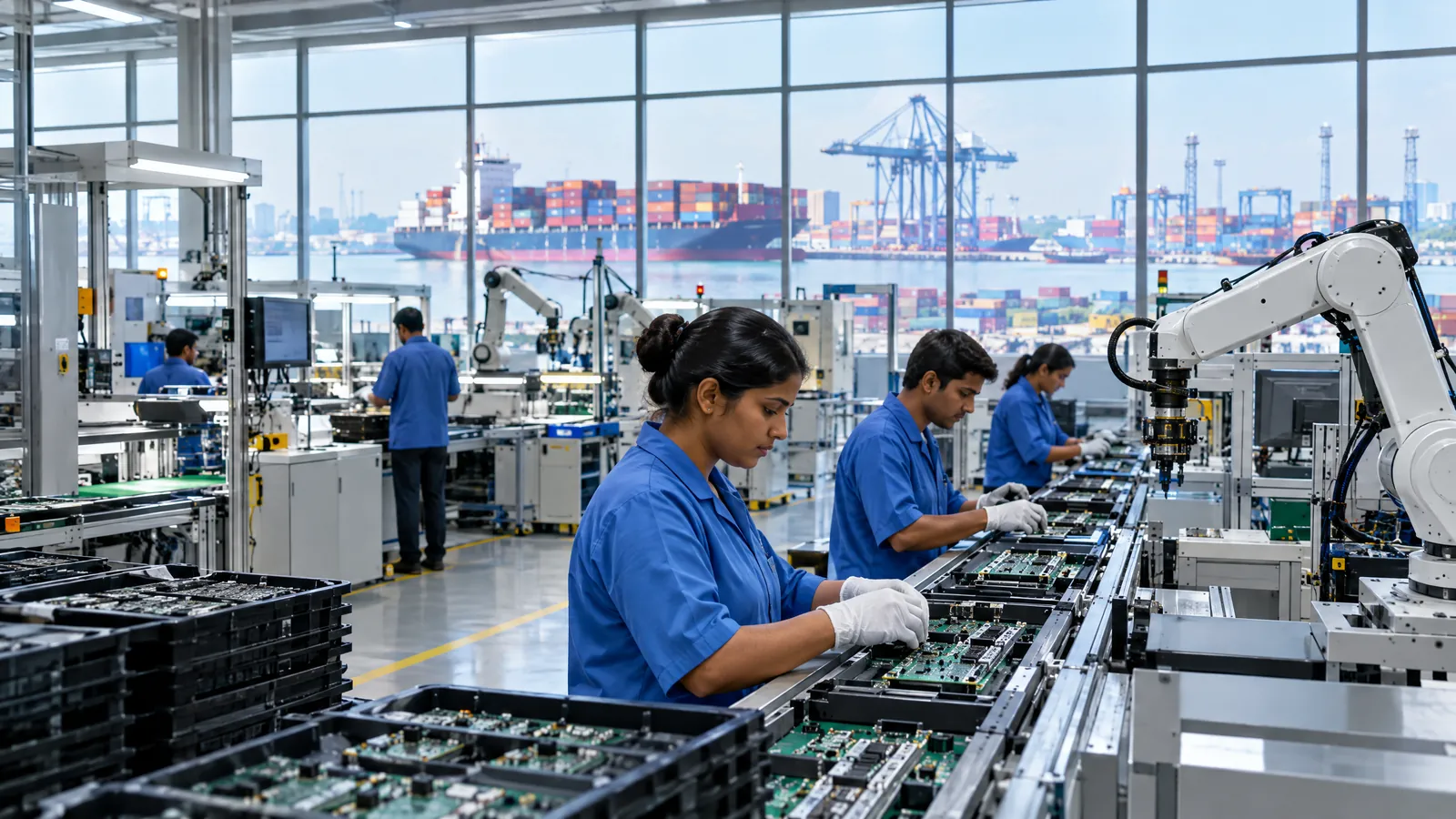
India’s most visible evidence of participation in this shift is electronics. The Ministry of Electronics and IT said electronics production rose to about ₹13.11 lakh crore in 2025–26, while electronics exports reached about ₹4.24 lakh crore. It also reported mobile-phone exports of about ₹2.59 lakh crore, and said smartphones became India’s top individual exported commodity in that fiscal year. These are government-reported figures, but they indicate the scale that mobile assembly has reached. [3]
Production-linked incentives, manufacturing clusters and a large domestic market have helped establish this base. Under the large-scale electronics manufacturing scheme, the government reported cumulative production of ₹11.62 lakh crore and exports of ₹6.43 lakh crore through March 2026, above the scheme’s original five-year targets. An external evaluation cited by the ministry put domestic value addition at 23% in 2023–24. [3]
That last measure is important. High output and export numbers do not automatically mean that every important input is made locally. A phone can be assembled domestically while relying heavily on imported chips, displays, precision parts and production equipment. The next question for India is therefore not only how many finished products leave a factory, but how much design, component manufacturing, testing, repair, tooling and supplier capability are located around it.
From assembly lines to a wider industrial ecosystem
India has several routes through which a broader manufacturing footprint could develop. Electronics creates demand for printed circuit boards, passive components, camera modules, enclosures, packaging, specialised machinery and quality-control services. Similar links matter in automotive components, pharmaceuticals, renewable-energy equipment, textiles and industrial machinery. A factory becomes more valuable to a local economy when nearby firms can meet exacting specifications repeatedly and deliver on schedule.
Policy is now explicitly aimed at those links. The government says the Electronics Components Manufacturing Scheme had approved 75 applications across 23 product categories by July, with approved units expected to bring ₹61,671 crore of investment and create 65,040 direct jobs over the scheme period. It also says 12 semiconductor projects had been approved, with three already in commercial production. Those plans could deepen local capability, although their eventual contribution will depend on execution, commercial demand and the ability to integrate with global customers. [3]
Diversification need not be a contest in which one country replaces another. Different sites can specialise: one may make components, another may assemble final goods, and a third may serve a regional market. For India, the practical task is to become a reliable part of several such networks. That requires fast customs processes, ports and roads that work predictably, affordable and dependable utilities, tested suppliers, and workers able to move into increasingly technical roles.
Costs, compliance and resilience remain the hard part
The same forces creating openings also create risks. UNCTAD says global trade entered 2026 under pressure from slower growth, geopolitical fragmentation, tighter national rules and a rise in tariffs, especially in manufacturing. It notes that roughly 18,000 new discriminatory trade measures have been introduced since 2020 and that technical regulations now affect around two thirds of global trade. For Indian exporters, compliance with product, environmental, labour and traceability requirements can be as decisive as wage costs. [1]
Energy and logistics costs are another shared vulnerability. In April, the World Bank said higher energy prices and supply-chain disruption were weighing on India’s activity, while describing trade diversification and policy buffers as sources of resilience. It also stressed the value of a predictable, business-enabling environment and cautioned that industrial policy has delivered mixed results across South Asia. [4] That is a reminder that incentive programmes can support a sector, but cannot substitute indefinitely for operational reliability and competitive firms.
There is also an international constraint. India’s manufacturers need access to imported capital goods, materials and specialised know-how even as they build local capacity. UNCTAD’s latest work on critical minerals shows how concentrated mining and refining remain, and how export restrictions and bilateral arrangements are multiplying. Securing inputs without closing markets or creating avoidable costs will be part of the policy balance. [6]
What happens next
The clearest indicators will be operational rather than ceremonial: the share of components sourced locally, the number of qualified domestic suppliers, delivery times at ports, power reliability, export quality and the range of markets served. Progress in those measures would show whether India is moving from a location for selected assembly work to a more embedded manufacturing partner.
The outlook remains uncertain. Tariff schedules, trade rules, energy costs and consumer demand can shift quickly, and firms may change plans as those conditions change. India’s manufacturing opportunity is therefore best understood as a continuing capability-building test, not a guaranteed outcome. External reporting and official sources were reviewed for this article.
Questions readers ask
What does supply-chain diversification mean?
It means using more than one country, supplier or transport route for production and distribution, so that a disruption in one place does not stop the whole chain. It does not necessarily mean leaving an existing manufacturing base.
Why is India relevant to the shift?
India combines a large domestic market with growing electronics production, a broad industrial base and policy programmes intended to develop manufacturing and components. The strength of those advantages varies by sector and location.
Does diversification mean production is leaving China?
Not necessarily. Many firms retain Chinese production while adding capacity elsewhere. Mature supplier networks, specialised inputs and production scale can make a complete move difficult.
Sources
- Global Trade Update (January 2026): Top trends redefining global trade in 2026 — UN Trade and Development (UNCTAD). Accessed 2026-09-23.
- Rewiring global value chains in a changing global environment — World Trade Organization. Accessed 2026-09-23.
- Production Linked Incentive Schemes Strengthen India's Electronics Manufacturing Ecosystem, Boosting Domestic Production, Exports and Value Addition — Press Information Bureau, Government of India. Accessed 2026-09-23.
- India Remains Among the Fastest-Growing Economies Even As Growth Slows Amid Middle East Conflict; Outlook Vulnerable to Risks and Uncertainty — World Bank. Accessed 2026-09-23.
- Companies left China to dodge tariffs. Now some are heading back — Reuters. Accessed 2026-09-23.
- Global Trade Update (June 2026): The shifting dynamics of critical minerals trade — UN Trade and Development (UNCTAD). Accessed 2026-09-23.
Anna News Desk reviewed external reporting and official sources published or accessible as of 23 September 2026. Google Trends Explore was not reliably accessible during research; no unverified search-volume claim is made. Government programme figures are attributed to the Government of India and are not presented as independently audited results. This explanatory article is not investment, legal or commercial advice.