At a glance: a creative toolchain meets a rights chain
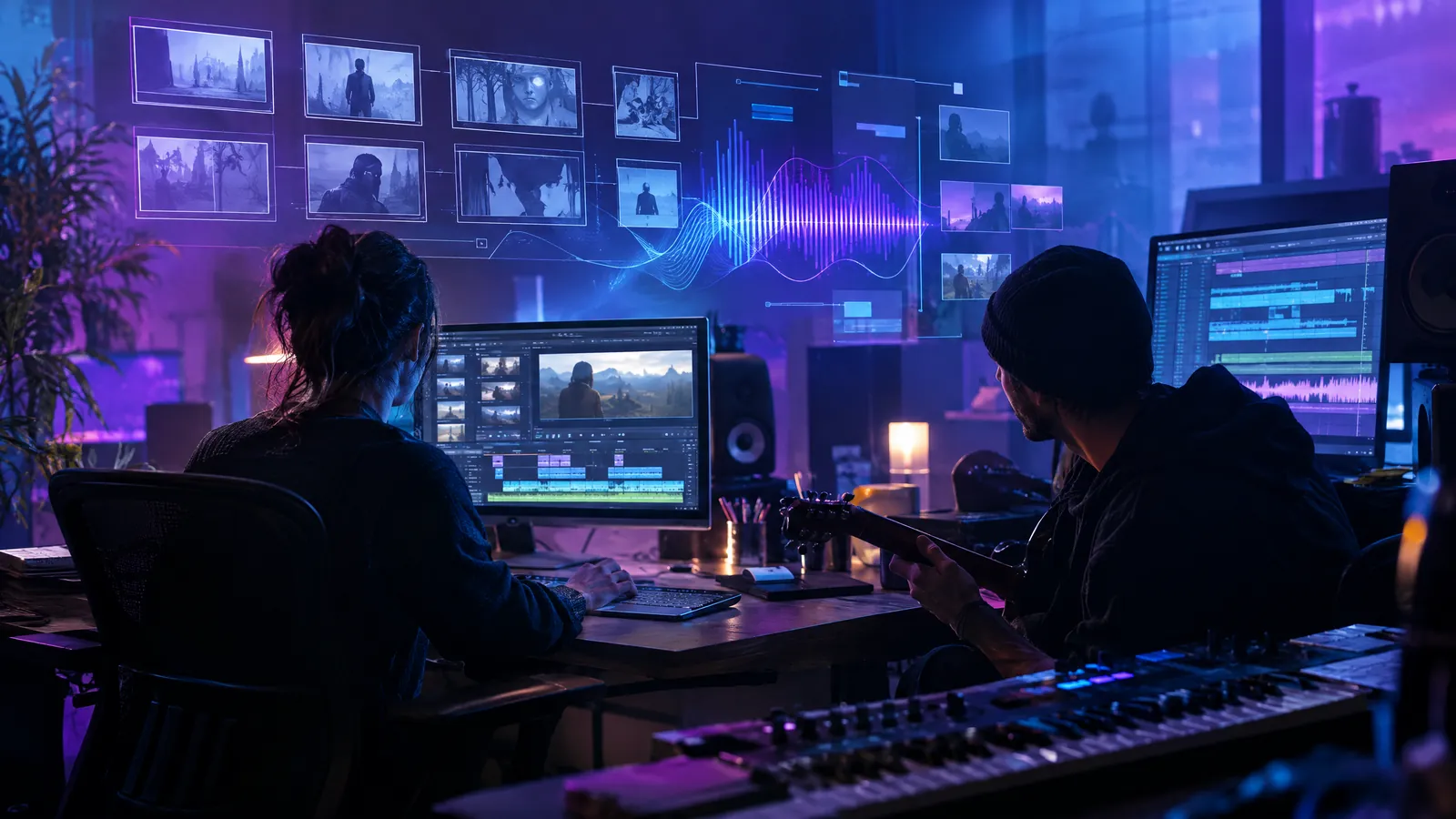
Artificial intelligence is moving from a novelty to a working tool in film and music. Editors can use it to organise footage, clean dialogue or test a rough cut; musicians can separate stems, repair noise, explore harmonies or make a demo before recording with people. A producer may also use generative systems for storyboards, temporary sound, subtitles, visual effects concepts or localisation. These uses can save time, especially for smaller teams, but they do not turn a complex creative production into a one-click process. Decisions about performance, taste, timing and context remain human responsibilities.
The legal and ethical questions begin before release. Was the model trained on material that was licensed or otherwise lawfully used? Did a contributor agree to a scan, voice model or reuse of a recorded performance? Is the final work substantially shaped by a person, and is it close enough to an existing song, recording, image or character to create a separate issue? These are distinct questions. A tool's terms may allow a customer to use an output, while copyright in an underlying work, a performer's contractual claim or a person's likeness interest may still require attention.
Interest in these distinctions has clear institutional signals, even though a verified public search total is not available. The European Union's transparency rules for certain AI-generated content took effect in August 2026, while general-purpose AI model rules already include transparency and copyright-related duties. [7] In the United States, the Copyright Office's AI project has separately examined digital replicas, copyrightability and training. The separation is useful: one debate is not a substitute for the others.
Where AI is fitting into film and music work
In filmmaking, the most routine applications tend to sit around the creative act rather than replace it wholesale. Software can transcribe interviews, search dailies, remove background noise, generate a temporary voice track, help match a dub to dialogue or assist with rotoscoping and clean-up. Concept images and pre-visualisation can help a director, cinematographer and production designer discuss a scene before a costly shoot. The value is often iteration: a team can compare options more quickly, then decide what to photograph, animate, perform or edit.
The practical dividing line is whether AI is assisting a documented creative process or supplying expressive material that nobody has checked closely. The U.S. Copyright Office's current position is that human-authored creative arrangements or modifications in an AI-assisted work may be protected, whereas a mere prompt is not enough where the system determines the expressive elements. That is a statement of US copyright policy, not a universal rule for every jurisdiction, but it explains why retaining working files and clear records of human choices matters. [1]
Copyright: training data, outputs and ownership are separate issues
The first copyright issue is upstream: how a model was developed. The Copyright Office's pre-publication report on generative-AI training says that collecting and curating protected material involves copying, and that those acts may implicate exclusive rights unless a licence or legal defence applies. It also examines fair use, potential market effects and licensing, rather than announcing a single answer for every model or dataset. [2] Court cases and negotiated licences can therefore matter as much as a platform's marketing description of its tool.
The output raises a separate issue. A generated song or image may reproduce protected expression or be too close to a recording, screenplay or design. It may also lack the same copyright protection as a human-created work. The Copyright Office says human authorship in an AI-assisted output can be protected, but material whose expressive elements are determined by a machine cannot. [1] A label saying 'made with AI' does not settle ownership.
Performer rights put consent and control at the centre
A convincing synthetic voice or screen likeness raises a different concern from copying a song. Performers may have negotiated rights in their recorded work, and people can have privacy, publicity, personality or other protections depending on the country. A digital replica can affect a livelihood and reputation even when it does not copy a particular copyright-protected recording. That is why consent, the purpose of use, duration, territory, compensation, approvals and the ability to refuse new uses have become central contract terms.
The US Copyright Office recommended a federal law against knowing distribution of unauthorised digital replicas in 2024, citing gaps in existing protection. [3] In June 2026, SAG-AFTRA members ratified television, theatrical and streaming contracts that the union says further restrict the use of synthetic performers and build on AI and digital-replica protections. Its accompanying explainer describes limits on use, consent in specified circumstances and residuals where a digital-replica use replaces a performance that would generate them. [5] These are union-contract protections, not rules that automatically apply around the world.
For Indian performers, the Copyright Act provides an exclusive right in a performance, recording and communication rights, and royalties for commercial use after consent to incorporation in a cinematograph film. It also protects identification and reputation against prejudicial modification. [6] The Act does not use the language of synthetic replicas, so application to an AI imitation will turn on the work, permission, contract and legal interpretation. Specific written permission is preferable to assumptions about an older recording or role.
Why music has become a focal point for licensing
Music makes the training debate especially visible because sound can evoke a performer or genre quickly, while a recorded track contains several layers of rights. The World Intellectual Property Organization notes that modern text-to-music systems are trained on pre-existing music and that opacity around commercial datasets has intensified questions about transparency and remuneration. It points to ongoing litigation involving major record companies and two AI music services, and discusses the difficulty of identifying whether a particular work was used in training. [4] Those questions are unresolved in many legal systems.
The least controversial uses are often those with a known source and a narrow purpose: cleaning a recording a musician owns, generating subtitles for a film with appropriate access, or using an authorised voice model under a defined agreement. Risk rises where material comes from an unclear dataset, an output is deliberately framed as a particular living artist, or a temporary production shortcut becomes public content without clearance. The context, not the word 'AI' alone, is what makes the difference.
What happens next
The next phase will be less about whether AI enters creative work and more about the rules around its use. EU transparency obligations provide one regulatory signal; the Commission says providers of generative AI must make AI-generated content identifiable, with certain deepfakes and public-interest text subject to visible labelling requirements. [7] Elsewhere, outcomes will be shaped by copyright cases, collective agreements, new licences and national laws. These approaches may not align, which is a challenge for a film or music release that travels across borders.
For audiences, transparency can make a practical difference when a voice, image or piece of music is synthetic or materially altered. For creators, the more immediate discipline is administrative as well as artistic: read tool terms, preserve permissions, identify human contributors, avoid directing a system to imitate a named artist, and seek specialist advice for a high-stakes release. None of these steps requires treating AI as either a threat or a cure-all. They recognise that creative tools work best when the people whose work, identity and judgment give culture its value remain visible and fairly treated.
Questions readers ask
Can an AI-generated song or film scene be copyrighted?
It depends on the jurisdiction and the human contribution. In the United States, the Copyright Office says copyright can protect sufficient human-authored expression, including creative selection, arrangement or modification in an AI-assisted work, but not expressive material determined by the system alone. Other countries may apply different rules.
Is permission to use a performer’s past recording permission to create a digital replica?
Not necessarily. The answer depends on the agreement, the purpose and territory of the new use, applicable performer and personality rights, and other law. A specific written agreement for a voice, scan or likeness use is safer than relying on a broad assumption.
What records should a film or music team keep when using AI?
Useful records include tool terms, licences, contributor consents, source-material details, prompts and revisions where relevant, and documentation of the human creative choices in the final version. The appropriate level of review depends on the project and its release plan.
Sources
- Copyright Office Releases Part 2 of Artificial Intelligence Report — U.S. Copyright Office. Accessed 2026-09-23.
- Copyright and Artificial Intelligence, Part 3: Generative AI Training (Pre-Publication Version) — U.S. Copyright Office. Accessed 2026-09-23.
- Copyright Office Releases Part 1 of Artificial Intelligence Report, Recommends Federal Digital Replica Law — U.S. Copyright Office. Accessed 2026-09-23.
- Royalties in the age of AI: paying artists for AI-generated songs — World Intellectual Property Organization. Accessed 2026-09-23.
- SAG-AFTRA Members Approve 2026 TV/Theatrical Contracts Tentative Agreement — SAG-AFTRA. Accessed 2026-09-23.
- The Copyright Act, 1957 — India Code, Government of India. Accessed 2026-09-23.
- AI Act: Regulatory framework — European Commission. Accessed 2026-09-23.
Reported by Anna News Desk. External reporting and official sources were reviewed on 23 September 2026, including materials from the U.S. Copyright Office, WIPO, SAG-AFTRA, India Code and the European Commission. Google Trends data was not extractable in this environment, so no exact search volume is claimed. This explanatory article is not legal advice.