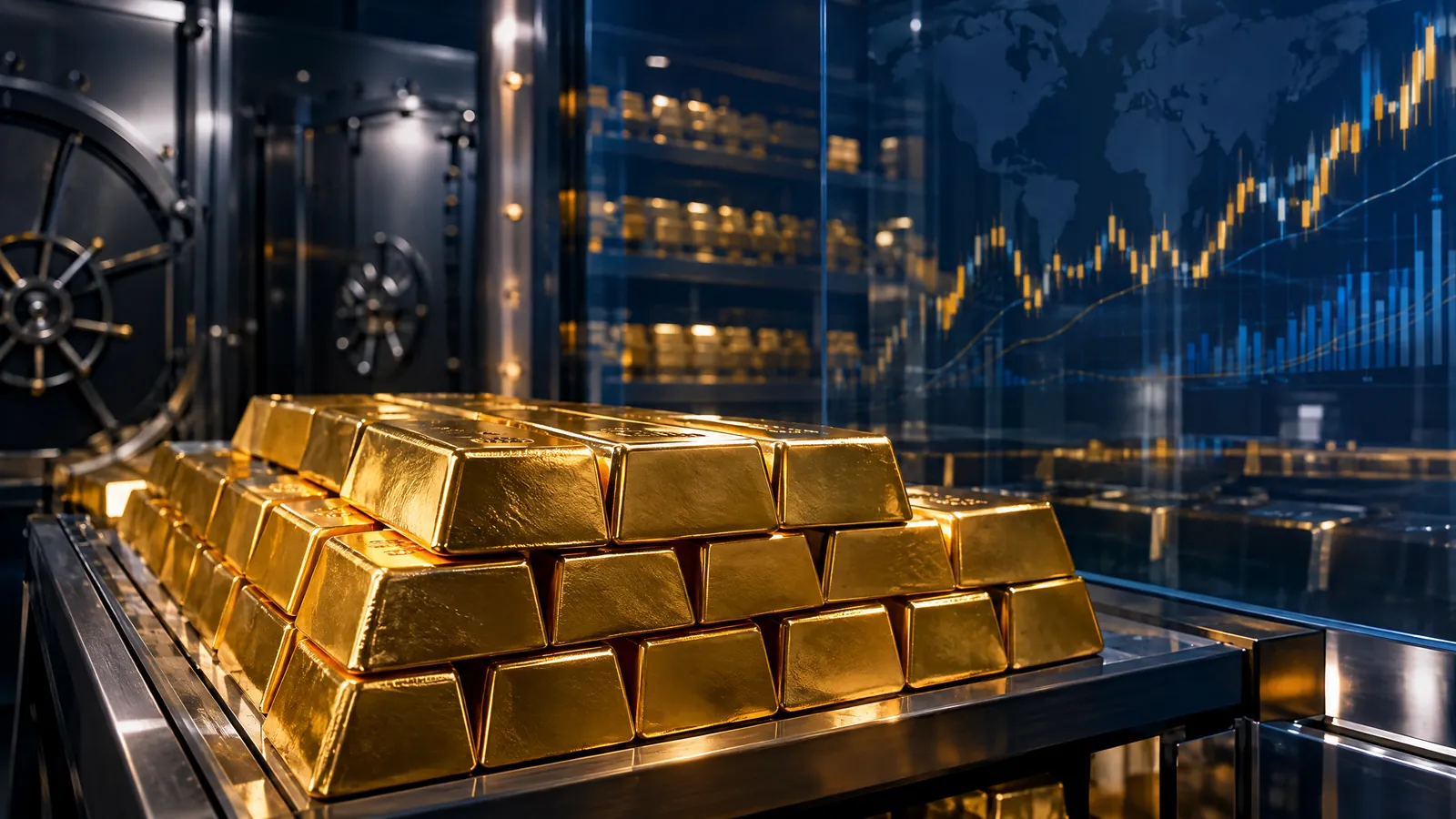
At a glance: several forces are pulling in opposite directions
Gold’s outlook on 23 September is best understood as a contest between short-term financial conditions and longer-running demand for a reserve asset. Bullion fell as investors assessed the prospect that major central banks would keep rates elevated to contain inflation. Reuters reported spot gold at $4,329.31 an ounce at 0623 GMT, down 0.6% on the day, while the US dollar reached a two-month high. That combination matters because gold is priced internationally in dollars and does not generate an interest payment. [1]
At the same time, the case for gold is not limited to a daily price move. Geopolitical uncertainty, inflation concerns and a desire to diversify reserve portfolios can sustain demand from households, funds and official institutions. Those influences work on different timetables. An exchange-rate or bond-yield move can affect the market within hours; central-bank reserve decisions, jewellery demand and mine supply typically unfold more gradually. The result can be sharp moves that do not settle the broader direction.
For a reader in India, the international quotation is only part of the story. A domestic rupee price is shaped by the dollar gold price and the rupee-dollar exchange rate, then by local premia and applicable levies. If the rupee weakens against the dollar, a stable international price can still translate into a higher local price; the reverse can also occur. This is why a global gold headline and a local jewellery quote need not move in lockstep.
Interest rates and real yields raise the opportunity cost
The clearest near-term headwind is the return available on cash and government bonds. When policy rates and bond yields rise, holding a non-yielding asset has a larger opportunity cost. The Federal Open Market Committee raised its target range by 25 basis points to 3.75%–4.00% on 16 September, saying inflation remained elevated and that the action would support a timely return to its 2% goal. [2] The decision does not mechanically determine gold’s next move, but it is a central part of the backdrop for dollar assets and yields.
Markets often focus on real yields, meaning nominal yields adjusted for expected inflation, rather than on the policy rate alone. A rise in real returns can make income-producing instruments comparatively more attractive. The World Gold Council’s July outlook similarly identified real yields, monetary-policy expectations and the US dollar as important influences on North American gold-fund flows. It also noted that these flows can be episodic rather than a permanent signal of demand. [5]
That relationship is important but not absolute. Gold can react positively if inflation expectations rise faster than nominal yields, if a growth shock changes expectations for future rates, or if stress increases demand for liquid perceived stores of value. Conversely, a rate increase can coincide with a gold rise if the dollar or long-dated Treasury yields fall. The post-decision trading in September illustrated that complication: Reuters reported a gold rebound on 17 September alongside a softer dollar and lower 10-year Treasury yield. [6]
The dollar is a global price channel, not just a US story
A stronger dollar usually makes dollar-priced gold more expensive in other currencies, which can cool overseas buying at the margin. Reuters linked the 23 September decline partly to that mechanism. [1] For import-dependent countries, currency conditions can therefore affect demand and local prices even when the physical gold market itself has not changed. It also explains why the same ounce of metal can look different to a buyer paying in rupees, yuan, yen or euros.
Currency effects should not be treated as one-way. The dollar responds to interest-rate differences, inflation expectations, economic data, energy prices and demand for safety in global markets. Some of those same factors can support gold. During periods of acute uncertainty, both the dollar and bullion can attract demand; at other times, a stronger dollar becomes the more immediate drag on gold. The useful conclusion is that ‘safe haven’ describes a role, not a guarantee of a particular daily outcome.
The currency lens also puts price comparisons in perspective. A dollar-based peak, a rupee-based retail price and an exchange-traded contract measure related but not identical things. Contract timing, currency conversion, local delivery costs and product purity can all differ. Readers comparing reports should check the unit, currency, time of quotation and whether the figure refers to spot metal, a futures contract or a retail product before drawing conclusions about the size of a move.
Central-bank buying provides support, but purchases are uneven
Central banks have become an important part of the longer-term gold discussion because reserve managers generally act for diversification, liquidity and risk-management reasons rather than short-term price momentum. World Gold Council data show net purchases by central banks and other official institutions rebounded to 289 tonnes in the second quarter of 2026, after a revised 57 tonnes in the first quarter. First-half net demand was 345 tonnes, the lowest first-half total since 2022, showing both the strength of the second-quarter rebound and the unevenness of the year so far. [3]
The reported country detail reinforces that nuance. Poland added 51 tonnes in the second quarter and China added 33 tonnes, while several other central banks also bought. Turkey’s sales moderated from the prior quarter, while Russia was the largest reported seller in the quarter. The World Gold Council cautions that official data can be delayed and revised, and it also points to unreported activity. These figures are therefore a useful demand signal, not a complete real-time ledger. [3]
Intentions appear supportive but should not be mistaken for confirmed future purchases. In the Council’s 2026 survey of 76 central-bank respondents, 89% expected global official gold reserves to rise over the following year and 45% expected their own holdings to increase. Respondents cited crisis performance, diversification and inflation hedging among the reasons for holding gold. [4] Those preferences help explain structural demand, while high prices, domestic liquidity needs and foreign-exchange management can still change the timing or scale of transactions.
What happens next: watch the evidence, not a single narrative
The next tests are likely to come from inflation and labour data, central-bank communications, the dollar and bond-market response, and developments that alter perceptions of geopolitical or financial risk. Official-sector reserve reports and fund-flow data can add a slower-moving demand perspective. The World Gold Council expects investment demand to be the principal source of gold-demand growth through the rest of 2026 and says central banks should remain significant buyers, but it also expects annual official demand to finish below the 2025 total. That is an outlook from an industry body, not a certainty. [5]
Google Trends was reviewed as a public-attention check, not as proof of demand. Its accessible India daily feed did not offer a verified query series or an exact volume for ‘gold price’, so this article makes no claim about a current search spike. The practical context is uncertainty: rates and currencies can move quickly, while reserve diversification and physical demand change more slowly. Gold can be influenced by all of them at once, and none alone provides an assured path for prices. External reporting and official sources were reviewed for this explainer.
Questions readers ask
Why do higher interest rates often weigh on gold?
Gold does not pay interest. When cash, deposits or government bonds offer higher returns, the opportunity cost of holding gold can rise. The relationship is not automatic because inflation expectations, the dollar and financial stress also affect demand.
Why can the gold price in India differ from the international price?
International gold is commonly quoted in US dollars per ounce. An Indian retail price also reflects the rupee-dollar exchange rate, conversion into grams, local premia and applicable levies, so it may move differently from the global dollar quotation.
Does central-bank buying guarantee that gold prices will rise?
No. Official purchases can provide a source of demand, but their timing and volume vary, data may be revised and prices also respond to interest rates, currencies, investment flows, supply and broader economic conditions.
Sources
- Gold lacklustre as higher-for-longer rate outlook weighs on sentiment — Reuters. Accessed 2026-09-23.
- Federal Reserve issues FOMC statement, 16 September 2026 — Board of Governors of the Federal Reserve System. Accessed 2026-09-23.
- Gold Demand Trends: Q2 2026 — Central Banks — World Gold Council. Accessed 2026-09-23.
- Central Bank Gold Reserves Survey 2026 — World Gold Council. Accessed 2026-09-23.
- Gold Demand Trends: Q2 2026 — Outlook — World Gold Council. Accessed 2026-09-23.
- Gold gains over 2% on weaker dollar, easing oil prices — Reuters. Accessed 2026-09-23.
- Google Trends Daily Search Trends, India — Google Trends. Accessed 2026-09-23.
Anna News Desk reviewed external reporting and official, institutional and industry sources listed above. This is neutral explanatory journalism, not personal investment advice or a price forecast. Market data, survey responses and outlooks can change as new information is released.