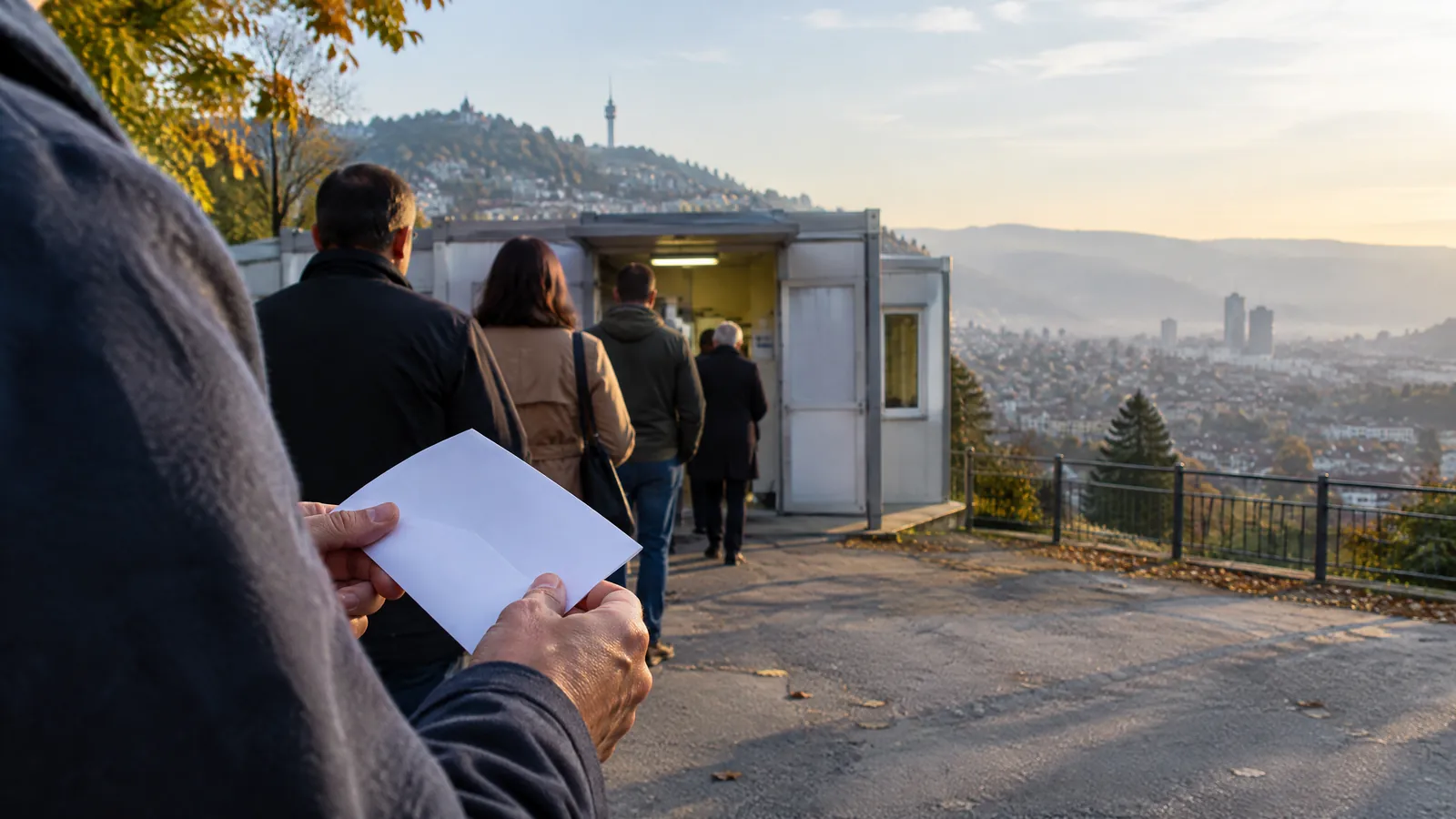
The direct answer: voting is on 4 October and results are still pending
Bosnia and Herzegovina will hold its 2026 general elections on Sunday 4 October. Polling is scheduled for 07:00–19:00 Central European Summer Time (CEST): 05:00–17:00 UTC, 06:00–18:00 BST in the UK and 10:30–22:30 IST in India. The vote covers state, entity and cantonal institutions; it is not a single nationwide presidential contest. The Central Election Commission of Bosnia and Herzegovina (CEC) formally called the election and its timetable confirms the polling window.[1] [2]
For anyone searching “Bosnia election 2026 results October 4”, the direct answer before voting is that there are no results, winners or turnout figures to report. What is confirmed is the voting date, the offices on the ballot, the legal timetable and the official CEC route to watch. Any number posted before the CEC begins publication should be treated with particular caution, not as an authoritative national return.[1] [3]
The first national CEC publication is scheduled as incomplete, unofficial preliminary results at 24:00 local time on 4 October — midnight at the start of 5 October in Bosnia and Herzegovina. That is 22:00 UTC, 23:00 BST and 03:30 IST on 5 October. It is a planned release point, not a promise that every contest or polling station will have reported by then; certification comes later.[2]
What voters elect — and what they do not elect directly
Voters are choosing six direct contests across three levels of government, all for four-year mandates. At the state level these are the tripartite Presidency of Bosnia and Herzegovina and the House of Representatives of the Parliamentary Assembly of Bosnia and Herzegovina. The CEC’s 2026 hub is the useful official starting point because it brings together the decision, conduct rulebook, deadlines and voter material rather than leaving readers to rely on social posts or old election pages.[3] [4]
In the Federation of Bosnia and Herzegovina (FBiH), voters also elect the FBiH House of Representatives and the assemblies of the ten cantons. In Republika Srpska (RS), they elect the National Assembly, the RS president and two RS vice-presidents. The CEC’s election call names those offices directly. Which ballot combination a person receives depends on the electorate and residence rules, so descriptions of “one Bosnia ballot” are misleading.[1] [4]
Several important institutions are not chosen directly on 4 October. After the direct contests, cantonal assemblies elect the FBiH House of Peoples; the FBiH House of Representatives and RS National Assembly elect the state House of Peoples; and the FBiH House of Peoples together with its House of Representatives elect the FBiH president and vice-presidents. This distinction matters when results-night coverage talks about a government or parliamentary chamber: indirect choices occur later and should not be announced as election-night outcomes.[4]
How the residence-based system works
The Presidency has a residence-dependent design. Voters registered in the FBiH elect a Bosniak and a Croat member, while voters registered in RS elect a Serb member; each is chosen by simple majority within the relevant electorate. The three members rotate in the presidency every eight months. Most seats in the state, FBiH and RS representative bodies use preferential voting in multi-member constituencies, alongside compensatory-seat mechanisms. These arrangements are why a national vote total alone cannot describe every contest.[4]
The core rule is that a BiH citizen aged 18 or over on election day has the right to vote if recorded in the Central Voters’ Register, subject to the legal exceptions set out in the election law. The law also provides that voting is personal and secret. It is a legal framework, not individual legal advice: people with a question about their own entry, residence status or special voting arrangement should use the CEC and relevant municipal election commission channels.[5]
The register figure needs a date. The CEC’s May election call recorded 3,414,364 voters in the register as it then stood; ODIHR’s later interim report says the final register closed on 20 August contains 3,408,517 voters. The later figure is the better pre-polling reference, while the earlier one remains a snapshot, not evidence of a sudden turnout change.[1] [4]
Voter access, documents and candidate information
For ordinary in-country voting, a voter goes to the polling station where they appear in the register and proves identity with a valid document. The election law requires electronic voter identification using biometric data alongside the document, with a document-only fallback where the electronic step cannot establish identity for a justified reason. The 2026 rulebook says the polling committee directs a voter who is at the wrong station to the correct place; it does not make a generic online article a substitute for checking the official record.[5] [6]
Out-of-country registration is no longer an open option for this election. The CEC’s deadline was 21 July, and its August update says 48,078 overseas voters were registered after the application and appeal process: 45,457 by post and 2,621 at diplomatic or consular missions. A citizen temporarily abroad who did not complete the required process should not assume that a postal or diplomatic ballot remains available; the governing rules and individual circumstances matter.[1] [7]
The CEC says certified candidate lists are available by constituency, selected through the voter’s municipality of residence, and it has published voter-instruction videos for FBiH, RS and Brčko District. Checking both before polling day is more reliable than using an image of a ballot shared online. A candidate list is also not a result: it identifies a certified choice, not a winner or a guarantee that a later tally will be complete.[8]
What is new about voting technology in 2026
This election is designed to introduce biometric identification and ballot scanning countrywide for the first time, alongside established paper-ballot procedures. Under the rulebook, voters are identified and authenticated with a valid document and fingerprint; if fingerprint authentication cannot establish identity, the committee can proceed on the identification document. If the device cannot operate and no replacement is available, the rulebook provides for identification using one of the authorised documents.[6]
The technology is relevant to speed, but it does not turn a scanner display into a final national verdict. ODIHR reports that scanner-generated preliminary results are transferred to the CEC while polling-station committees also perform a manual count, whose results are entered into the protocol and results-management platform. Where electronic and manual counts differ, the law does not prescribe a mandatory recount on that basis; recounts remain at the CEC’s discretion.[4]
The latest CEC preparation notice, dated 25 September, says device testing and configuration, ballot printing and inspection, QR-code verification and training were continuing. An earlier mock exercise found the technology broadly functional but also exposed ballot-delivery problems in 14 municipalities; the CEC said it would use that lesson for the 4 October operation. Readers should therefore distinguish confirmed procedures from the still-mutable reality of individual polling-station operations.[9] [10]
Where official Bosnia election results will appear
Use the CEC’s General Election 2026 page as the official starting point on polling day and follow its election-results link or notices when they are activated. The official timetable requires polling-station results and municipal/city consolidated summaries to be publicly posted no later than 12 hours after closing. That local publication is useful evidence of progress, but it is not the same thing as a nationwide, checked or certified result.[2] [3]
The CEC’s schedule then sets national preliminary-result publications at midnight on 4 October; at 02:00 and 19:00 on 5 and 6 October; daily at 16:00 from 7 to 10 October; and every 48 hours from 11 October until confirmation. Times are local Bosnia and Herzegovina time unless the CEC says otherwise. These are status updates built into the official timetable, not a forecast of when a particular Presidency, parliament or local area will be decided.[2]
Certified results have a different status. The CEC’s target is confirmation by 3 November at the latest, with an exceptional extension to 20 November. Appeals, checks and counting processes can matter before that endpoint. As at this pre-election guide, no official nationwide results dashboard address, broadcast schedule or result-night livestream has been confirmed in the CEC material reviewed here; readers should use the CEC link rather than assume a television or social-media feed is official.[2] [3]
Preliminary, manual-count and certified results are not interchangeable
A simple status test can prevent misleading headlines. “Pending” means the CEC has not posted a figure. “Incomplete preliminary” is the CEC’s own description for early official releases and must not be shortened to final results. A polling-station posting may be a local record; a CEC consolidated or updated preliminary figure is wider but remains provisional. “Certified” should be reserved for the CEC confirmation decision, not a candidate’s declaration of victory.[2] [6]
The manual-count safeguard is especially important this year. The ODIHR report explains that both scanner transmissions and manual counts feed the results system, and that statutory mandatory recounts concern a discrepancy of more than two per cent between voters who voted and ballots in a box. It also says other scanner/manual discrepancies can be considered by the CEC. A change in a tally is therefore not, by itself, proof of wrongdoing or a reversal of a certified outcome.[4]
ODIHR’s election observation mission will monitor opening, voting, counting and tabulation, and says it will issue preliminary findings and conclusions at a 5 October press conference with partners. That statement is an observation assessment, not the legal certification of a winner. The mission’s final report is expected months after the process, which is another reason to separate an election-night number, the CEC’s result process and an observer’s analysis.[11]
A practical checklist for 3–5 October
Before Sunday, confirm the correct constituency, polling location and candidate list through the CEC’s 2026 information pages, and take a valid identification document. Voters should allow for the new identification process but should not infer an individual entitlement from this guide. The formal election-silence period begins at 07:00 CEST on Saturday 3 October and runs until polling stations close; the CEC timetable also sets specified media restrictions during that period.[2] [8]
On 4 October, keep the time-zone distinction clear. Bosnia and Herzegovina’s 19:00 CEST closing time is 17:00 UTC, 18:00 BST and 22:30 IST. People already in a polling-station queue at the legal closing time may vote under the election law. A delayed opening or interruption can also lead to an extension under the legal rules, so a local CEC notice takes precedence over a generic closing-time conversion.[5]
After polls close, recheck the CEC rather than copying partial graphics. Record whether a number is a local posting, incomplete preliminary result, later preliminary update or certified result, and note its timestamp and contest. Do not extrapolate a winner, turnout pattern, coalition or indirect appointment from an early return. This guide will need a factual update if the CEC changes a procedure, timing or official results link.[2] [3]
Questions readers ask
When is the Bosnia and Herzegovina election in 2026?
The general election is on Sunday 4 October 2026. The CEC timetable schedules polling from 07:00 to 19:00 local CEST, which is 05:00–17:00 UTC and 10:30–22:30 IST.[2]
What offices are being elected in Bosnia and Herzegovina on 4 October?
The direct contests cover the BiH Presidency and state House of Representatives; the FBiH House of Representatives and ten cantonal assemblies; and the RS National Assembly, president and two vice-presidents.[1] [4]
Can every voter choose every member of the BiH Presidency?
No. Voters registered in the Federation of BiH elect a Bosniak and a Croat Presidency member, while voters registered in Republika Srpska elect a Serb member. The rules are residence-dependent.[4]
Who can vote in Bosnia and Herzegovina’s 2026 election?
The general rule is that BiH citizens aged 18 or older on election day who are recorded in the Central Voters’ Register can vote, subject to legal exceptions. Individual register or residence issues should be checked with the CEC or relevant local election authority.[5]
Were Bosnians abroad still able to register to vote after September?
No. The CEC’s deadline for applications to vote outside Bosnia and Herzegovina was 21 July 2026. Its later update reported 48,078 registered overseas voters after the process and appeals.[1] [7]
When will official Bosnia election results start to be published?
The CEC timetable schedules incomplete, unofficial preliminary national results at 24:00 local time on 4 October, followed by specified updates. A local polling-station posting is not the same as a national certified result.[2]
When will Bosnia and Herzegovina’s 2026 election results be final?
The CEC is scheduled to confirm results by 3 November 2026 at the latest, exceptionally by 20 November. Until the CEC confirmation, early figures should be described as preliminary or incomplete rather than final.[2]
Sources
- General elections in BiH scheduled for Sunday, October 4, 2026 — Central Election Commission of Bosnia and Herzegovina. Accessed 2026-09-30T11:10:00+05:30.
- Instruction on deadlines and the sequence of election-related activities for the 2026 General Elections — Central Election Commission of Bosnia and Herzegovina. Accessed 2026-09-30T11:10:00+05:30.
- General election 2026 — Central Election Commission of Bosnia and Herzegovina. Accessed 2026-09-30T11:10:00+05:30.
- Bosnia and Herzegovina, General Elections, 4 October 2026: Interim Report — OSCE Office for Democratic Institutions and Human Rights. Accessed 2026-09-30T11:10:00+05:30.
- Election Law of BiH — unofficial consolidated version — Central Election Commission of Bosnia and Herzegovina. Accessed 2026-09-30T11:10:00+05:30.
- Rulebook on the Conduct of the 2026 General Elections in Bosnia and Herzegovina — Central Election Commission of Bosnia and Herzegovina. Accessed 2026-09-30T11:10:00+05:30.
- Ongoing activities on the conduct of 2026 General Elections — Central Election Commission of Bosnia and Herzegovina. Accessed 2026-09-30T11:10:00+05:30.
- Information for Voters and Election Administration — Central Election Commission of Bosnia and Herzegovina. Accessed 2026-09-30T11:10:00+05:30.
- Timely preparation and smooth conduct of the electoral process — Central Election Commission of Bosnia and Herzegovina. Accessed 2026-09-30T11:10:00+05:30.
- Mock elections – Challenges and lessons learned — Central Election Commission of Bosnia and Herzegovina. Accessed 2026-09-30T11:10:00+05:30.
- Bosnia and Herzegovina, General Elections, 4 October 2026 — OSCE Office for Democratic Institutions and Human Rights. Accessed 2026-09-30T11:10:00+05:30.
Anna News Desk prepared this pre-election guide from CEC primary material and OSCE/ODIHR election-observation documentation, read on 30 September 2026. It explains published rules and status labels, not individual legal eligibility or voting advice. Polling-station operations, candidate lists, technical arrangements, result links, preliminary figures, recounts, appeals and certification remain mutable. No winner, turnout, coalition, broadcast or results outcome is predicted, and the article does not guarantee access, traffic, rankings, indexing or placement.